The Problem
After attending a Connor, Clark & Lunn Investment Management panel, we learned that quant researchers run hundreds of model iterations across different datasets to validate trading signals. Each run generates critical metrics (Information Coefficient, Rank IC, t-statistics) that need to be tracked and compared.
Git doesn't work for this workflow. It tracks code changes, but not the actual models, datasets, or performance metrics. Researchers were juggling spreadsheets, notebooks, and manual documentation just to remember which model and dataset combination produced which IC scores. There was no bird's-eye view of experiments.
The Solution
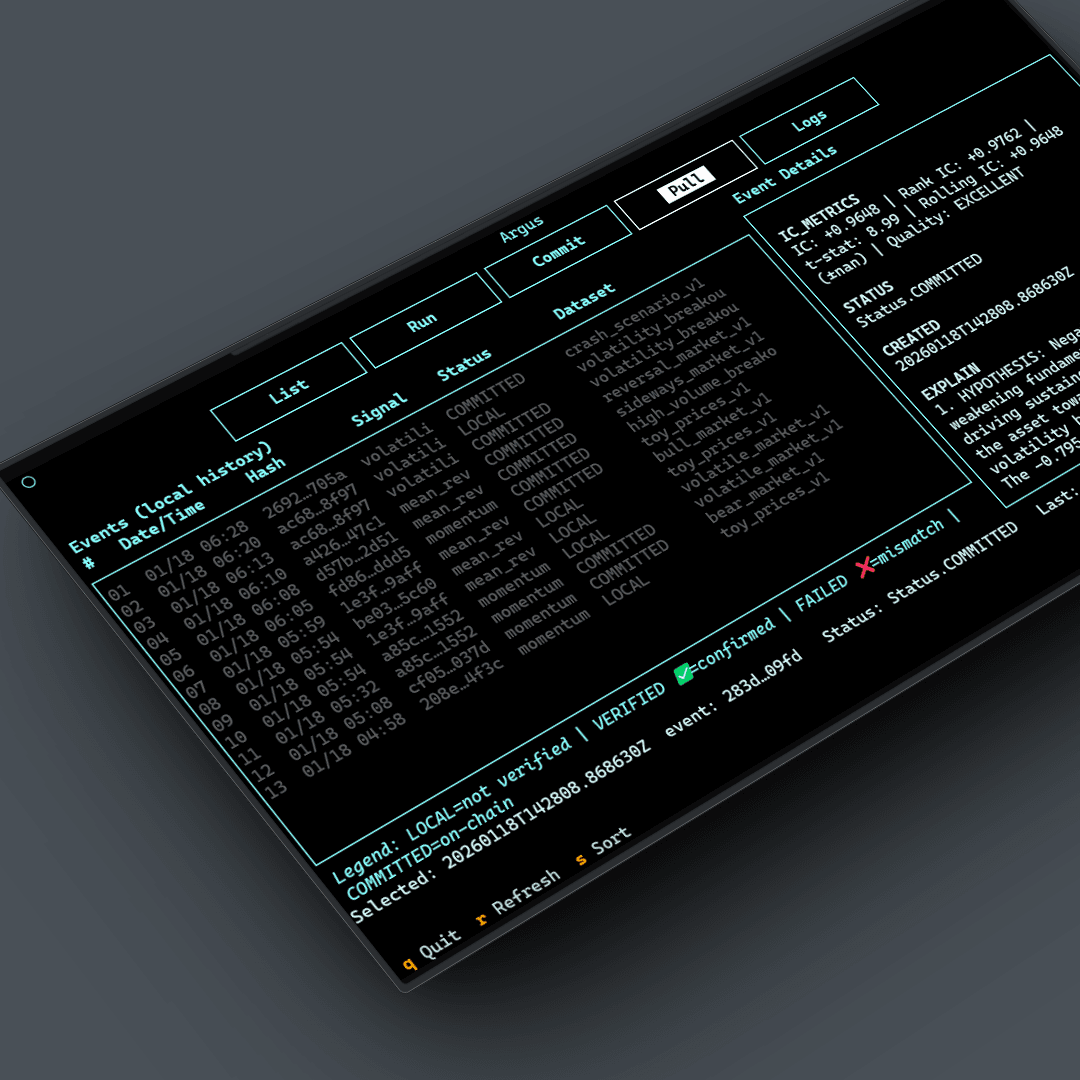
Argus brings Git-style version control to quantitative research. Every model run gets a unique hash, storing the exact model, dataset, and performance metrics (IC, Rank IC, t-stat) in an immutable record. Query past experiments, compare results, and replay any run deterministically.
Think git commit but for your trading models. Argus integrates directly into research workflows via a terminal UI. Makes experiment tracking as natural as version controlling code.
Technical Architecture
Core hashing and versioning engine written in Rust for performance and immutability guarantees. Python middleware connects Rust to the Textual-based terminal UI. Provides a native command-line experience that fits into existing workflows.
Gemini AI automatically generates summaries of model runs, extracting insights from metrics. SQLite provides fast local storage while Vultr handles long-term cloud backup of models and datasets. This enables collaboration and remote experiment access.
Winning nwHacks
Built the entire system in 36 hours. From learning quantitative finance concepts to shipping a working terminal UI. The biggest technical challenge was integrating Rust with Python while maintaining a smooth command-line interface.
Judges recognized Argus for solving a real problem in quantitative finance with technical depth. The hash-based versioning system provides immutable audit trails, which is critical for reproducible research in financial modeling.
What's Next
Native Jupyter Notebook integration is next. Most quant researchers live in notebooks, so we're building a seamless plugin that lets them commit runs without leaving their research environment.